Eritrea: Regime calls off new calls for military training

(Asmara 02-01-2015) Freedom Friday (Arbi Harnet) activists in Asmara have this afternoon confirmed that the Eritrean regime has called off the announcements requiring many Asmara residents to report for training, tomorrow 3rd of January 2015.

The calls were issued with stern warning of severe repercussion for those who failed to report for training some three weeks ago. However sensing the determination to ignore these calls just like the previous calls in October authorities in the Central Region of the country have started spreading last minute messages about the postponement of the training.

The activists stated: ‘Asmara residents were determined to ignore these calls just like the three previous calls, but they [the regime] backtracked at the last minute and tonight nearly everyone, at least here in “zoba maekel” are aware that it has been called off, we don’t think they will ever pursue the plan again. If the challenge from the public is maintained at this level there is no reason why we won’t see the end of the regime in this new year’.

Three weeks ago all members of the Popular Army and members of the national service who have not registered were informed to report for training on the 3rd of January and sternly warned about repercussions of failing to report. It was feared that the regime will force people to go to “Gahtelay Military training Center”, renown for its inhospitable climate, where the elderly recruits of the Popular Army would have found impossible to cope with.

The repeated show of quiet resistance has become a norm in the Capital where there is a growing confidence and solidarity among residents, who have stood firm in their determination to resist forced militeraisation of the civilian population.

—end—

Notes

The Popular Army in Eritrea is made up of civilians over the age of fifty, who are required to get armed and trained and be on call for duties in their local area, including night patrols.

Eritrea’s biggest prison for journalists in Africa

This hermetic country, known as ”the Korea North Africa” is in last place in the ranking of RSF in terms of press freedom 2014

Thirty journalists languishing in Eritrean prisons, detention without charges or known for his ”criticism of the government” in the country that has become the biggest prison for journalists in Africa, according to the latest report on press freedom Reporters Without Borders (RSF).

The exact number of imprisoned journalists is unclear, as the Eritrean government prevents entry to international observers, told Efe director for Africa of the Committee to Protect Journalists (CPJ, in English), Tom Rhodes. ”It is difficult to know what is happening there.”

This hermetic country, known as ”the Korea North Africa” is in last place in the ranking of RSF in freedom of the press in 2014, behind even China, Syria or Iraq.

Eritrea is also second in the world with more journalists imprisoned, only behind China.

africa-mapa-paisesNF, Eritrean journalist who fled after being imprisoned three times and prefers not to be named, tells Efe that during his captivity, torture such as sleep deprivation, beatings, bread and water diets were frequent, although there were various levels chords the crime committed.

”Mine was the lowest. The others wanted to have my level of torture ” recalled in a phone interview.

N.F. explains that there is a ”climate of fear” among Eritrean journalists by infiltrating government informers media; just a complaint to be transferred to a ”field of torture”.

No private media and those that are government-owned, still an ”ultra-nationalist” and belligerent speech where censorship is total. Freedom of speech, press, assembly and association are limited.

Rhodes claims that Eritrea is ”the most censored country in the world,” where there are no critical voices against the Executive, which would be ”suicide” for the current government of the People’s Front for Democracy and Justice (PFDJ in english).

”There is a red line that can not be crossed, warns the journalist eritreo- but sometimes the journalists do not realize.”

It may take months between the Government discusses what is published and police calls the doorstep. ”I blindfolded and take you to a prison ’complaint.

In this climate of terror, the Eritrean journalists follow government guidelines, which convert well to the media at a ”propaganda machine”.

Since 2001 President Issayas Afeworki close down all privately owned media in Eritrea, foreign correspondents have been expelled and there is no longer any in the country. Meanwhile, government censors filter the news coming from abroad.

Thus, according to RSF report, the Government has prevented the arrival of any news about the Arab Spring and internet penetration in the country is tiny, controlled by the only existing telecommunications company, which belongs to the State.

The only way to obtain information not censored by the government is on the websites of the diaspora, although it is necessary to make these queries with caution because the complaint just a spiteful neighbor to finish detainee says NF

The government uses these arbitrary arrests to intimidate journalists, for reasons ranging from political opposition to practice no religion recognized by the state, evading conscription or trying to flee the country, told Efe researcher to Eritrea Amnesty International, Rachel Nicholson.

And even if they could, account Nicholson, flee entails other dangers, especially for those who remain: the government retaliates against the family of those who manage to escape the authoritarian country.

The ”paranoid” Government of Eritrea, according to the organization ”Index on Censorship”, rejects accusations of NGOs and Western governments over its violations of human rights and argues that they are ”politically motivated.”

Those journalists who publish criticism of his management, or suspected of not agreeing with the party, accused and arrested for acting ”against the interests of the nation” Rhodes concludes.

Eritrea’s biggest prison for journalists in Africa

Alicia Alamillos / Efe. Nairobi.

Thirty journalists languishing in Eritrean prisons, detention without charges or known for his ”criticism of the government” in the country that has become the biggest prison for journalists in Africa, according to the latest report on press freedom Reporters Without Borders (RSF). The exact number of imprisoned journalists is unclear, as the Eritrean government prevents entry to international observers, told Efe director for Africa of the Committee to Protect Journalists (CPJ, in English), Tom Rhodes. ”It is difficult to know what is happening there.”

This hermetic country, known as ”North Korea of Africa”, is in last place in the ranking of RSF in freedom of the press in 2014, ahead even of China, Syria or Iraq.

Eritrea is also second in the world with more journalists imprisoned, only behind China.

ADVERTISEMENT

NF, Eritrean journalist who fled after being imprisoned three times and prefers not to be named, tells Efe that during his captivity, torture such as sleep deprivation, beatings, bread and water diets were frequent, although there were various levels chords the crime committed.

”Mine was the lowest. The others wanted to have my level of torture” recalled in a phone interview.

N.F. explains that a ”climate of fear” among Eritrean journalists by infiltrating government informants in the media; just a complaint to be transferred to a ”torture camp”.

No private media and those that are government-owned, follow a ”ultranationalist” belligerent, where censorship is full speech. Freedom of speech, press, assembly and association are limited.

Rhodes claims that Eritrea is ”the most censored country in the world” where there are no critical voices against the Executive, which would be ”suicide” for the current government of the People’s Front for Democracy and Justice (PFDJ in english).

”There is a red line that can not be crossed, warns the journalist eritreo- but sometimes the journalists do not realize.”

It may take months between the Government discusses what is published and police calls the doorstep. ”I blindfolded and take you to a prison,” complains.

In this climate of terror, the Eritrean journalists follow government guidelines, which convert well to the media on a ”propaganda machine”.

Since 2001 President Issayas Afeworki close down all privately owned media in Eritrea, foreign correspondents have been expelled and there is no longer any in the country. Meanwhile, government censors filter the news coming from abroad.

Thus, according to RSF report, the Government has prevented the arrival of any news about the Arab Spring and internet penetration in the country is tiny, controlled by the only existing telecommunications company, which belongs to the State.

The only way to obtain information not censored by the government is on the websites of the diaspora, although it is necessary to make these queries with caution because the complaint just a spiteful neighbor to finish detainee says NF

The government uses these arbitrary arrests to intimidate journalists, for reasons ranging from political opposition to practice no religion recognized by the state, evading conscription or trying to flee the country, told Efe researcher to Eritrea Amnesty International, Rachel Nicholson.

And even if they could, account Nicholson, flee entails other dangers, especially for those who remain: the government retaliates against the family of those who manage to escape the authoritarian country.

The ”paranoid” Government of Eritrea, according to the organization ”Index on Censorship”, rejects accusations of NGOs and Western governments over its violations of human rights and argues that they are ”politically motivated”.

Those journalists who publish criticism of his management, or suspected of not agreeing with the party, accused and arrested for acting ”against the interests of the nation” Rhodes concludes.

Western firms reduce Eritrean miners to ’abject slavery’, UK MPs say

Early day motion slams mining companies for using forced labour in collusion with repressive Eritrean government and adding to the country’s human exodus

Western mining companies operating in Eritrea are reducing workers to “abject slavery” at their mines and worsening a human exodus that is driving more than 5,000 people out of the country every month, a group of British MPs has said.

An early day motion, signed by 41 MPs, blasts Eritrea’s poor human rights record, condemning “arbitrary arrest and detention and compulsory military service” carried out by the government.

The bill “notes with concern the collusion between the government of Eritrea and the international mining companies from the UK, Canada and Australia, which is using the forced labour of Eritreans for work in extractive industries in conditions which have been described as abject slavery”.

MPs called on the Eritrean government to allow Sheila Keetharuth, the UN’s special rapporteur on human rights in Eritrea, to travel to the country and assess claims of widespread rights violations. Keetharuth has not been allowed to enter the secretive country since her appointment in 2012.

The bill’s primary sponsor, Labour MP Jeremy Corbyn, said: “The mining companies that so happily work with the Eritrean government need to look at themselves – as do other governments who are well aware of the situation there – and insist on the special rapporteur visit as the beginning of the international awareness of the level of human rights abuses.”

Eritrea’s harsh national service programme, which requires all citizens over the age of 18 to enlist in the military or work for state-run companies, was linked to the exploitation of workers in the country’s mining sector in a 2013 report by Human Rights Watch (HRW).

In response to HRW’s report, the Canadian mining company Nevsun Resources commissioned an independent assessment (pdf) of working conditions at its Bisha mine, in which the Eritrean government holds a 40% stake (pdf). “Since 2009, Bisha Mining Share Company has implemented screening procedures and dialogue with the management of its main suppliers, contractors and subcontractors to implement the prohibition against using national service programme workers at the Bisha mine,” the report said.

Last month, three Eritrean refugees filed a lawsuit against Nevsun in a Canadian court over allegations that they were forced to work at the company’s Bisha mine against their will.

More than 300,000 Eritreans have fled the country so far, according to the UN refugee agency, UNHCR. Many migrants embark on a dangerous journey through Sudan, Egypt and Libya, risking kidnapping and torture, before trying to cross the Mediterranean and settle in Europe.

The Liberal Democrat MP Sarah Teather, who sponsored the motion, said: “The situation for Eritreans is appalling, with ongoing human rights abuses forcing thousands to leave every month. I’m particularly worried about the extremely vulnerable position that those fleeing find themselves in.”

“[Eritrean migrants] are disproportionately represented in the boats crossing the Mediterranean, with almost half of all arrivals via this route in 2014 from Eritrea and Syria. Many fall into the hands of human traffickers on the way. Tragically, many others have drowned. That’s why the Eritrean government must honour its international human rights obligations – allowing a visit from the UN would be a good first step.”

Denmark: Eritrea Immigration Report Deeply Flawed

(Brussels, December 17, 2014) – A Danish immigration report on Eritrea that suggests changing refugee policy for Eritrean asylum seekers is deeply flawed. Denmark and other European governments should await the outcome of the United Nations Commission of Inquiry on Eritrea, established in June 2014, before considering any major policy changes concerning Eritrea.

The Danish report suggests that the Eritrean government may be carrying out reforms that would allow Eritrean asylum seekers fleeing Eritrea’s abusive, indefinite national conscription program to be safely returned to the country. The number of Eritrean asylum seekers and migrants fleeing Eritrea and arriving in Europe has surged in recent years. A very high rate of Eritrean asylum seekers are granted refugee status or some other protected status in Europe, according to the UN High Commissioner for Refugees (UNHCR)’s statistics.

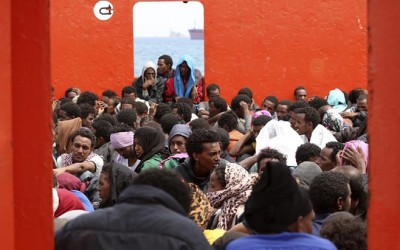
Migrants wait aboard a navy ship before being disembarked in the Sicilian harbour of Augusta  “The Danish report seems more like a political effort to stem migration than an honest assessment of Eritrea’s human rights situation,” said Leslie Lefkow, deputy Africa director. “Instead of speculating on potential Eritrean government reforms, host governments should wait to see whether pledges actually translate into changes on the ground.”

According to UNHCR, the number of Eritreans arriving in Europe tripled in 2014 to nearly 37,000 in the first 10 months.

Eritrea is isolated politically, both regionally and internationally, and is under UN sanctions due to its alleged past support for the militant group Al-Shabaab in Somalia. Some observers suggest that interest by European governments in stemming migration from the Horn of Africa is the main impetus for a variety of changes in policy toward the country, including the assessment of refugee policy.

Eritrea was among the African governments that met with European Union member states in Rome on November 28 as part of the EU-Horn of Africa Migration Route Initiative (also known as the Khartoum Process). Its stated aim is to prevent human trafficking and smuggling of migrants from the Horn to Europe.

The November report from the Danish Immigration Service, largely based on interviews with anonymous diplomatic and other sources in Eritrea, contains contradictory and speculative statements about Eritrea’s human rights situation. The sources also often qualify their statements, noting that there is no independent access to detention centers, that the fate of people returned to Eritrea is unclear, and that government reforms of the national service conscription are rumored, but not confirmed. There is no indication that the authors of the report interviewed victims or witnesses of human rights violations in Eritrea, and a prominent Eritrean academic consulted for the report has publicly criticized it.

Eritrea is one of the most closed countries in Africa, with no independent media, local nongovernmental organizations, or political opposition. The degree of government repression makes independent fact-finding in the country especially hard, including the difficulty of protecting interviewees from government reprisals. Eritrean refugee accounts are a primary source of information for international human rights investigators for this reason.

Eritrea’s dire human rights situation has been widely reported, including by a UN special rapporteur on Eritrea who has published several authoritative and damning reports on conditions. Human Rights Watch has not found any significant improvement in the human rights conditions in the past year.

The most common patterns of abuse in Eritrea include indefinite military conscription; forced labor during conscription; arbitrary arrests, detentions, and disappearances; torture and other degrading treatment in detention; restrictions on freedoms of expression, conscience, and movement; and repression of religious freedom. Eritrea’s policy of national service or military conscription is a significant reason for many young Eritreans to flee the country. By law each Eritrean is compelled to serve 18 months in national service starting at age 18, but in practice conscripts serve indefinitely; many for over a decade.

In June, the UN Human Rights Council condemned Eritrea’s “continued widespread and systematic violations of human rights and fundamental freedoms,” and adopted a resolution establishing a commission of inquiry to investigate abuses in Eritrea.

European governments should not make major policy changes toward Eritrea until they see the commission of inquiry findings, Human Rights Watch said.

“If the Eritrean government is really ready to carry out human rights reforms, it needs to give the UN commission of inquiry access so that it can make an objective assessment of progress,” Lefkow said. “The Eritrean government’s willingness to cooperate with the commission of inquiry will be the first test of whether it is ready to change course.”

More reporting on: http://www.hrw.org/news/2014/12/17/denmark-eritrea-immigration-report-deeply-flawed