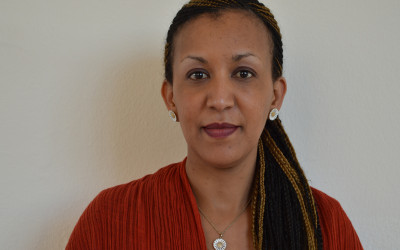
Eritrean gospel singer Helen Berhane was tortured for her beliefs. Now she’s speaking up.

ROME (RNS) Gospel singer Helen Berhane found new life in Europe after fleeing Eritrea, where she was locked in a shipping container and tortured for her religious beliefs.

Berhane, who was released in 2006 after spending 32 months in custody, spoke recently at a Rome conference on Christian persecution in the hopes others might learn of the grievous human rights violations in her native land. The “Under Caesar’s Sword” conference was organized by the Center for Civil and Human Rights at the University of Notre Dame and the Religious Freedom Project at the Berkley Center for Religion, Peace and World Affairs at Georgetown University. The topic of Christian persecution has been highlighted numerous times by Pope Francis during his papacy.

“The only reason they let you go is when they torture you to death,” she said. “They don’t want you to die in prison, it’s not their responsibility, so they send you home to die.”

Berhane, who was arrested for evangelizing and releasing religious music, was released only after she became deathly ill.

READ: Trump ties Pope Francis as second ‘most admired,’ behind Obama

Her account is corroborated by Amnesty International.

Fisseha M. Tekle, a researcher at the organization’s East Africa office, described prison conditions as “appalling” and said detainees are subjected to torture and deprived of adequate food, water and sanitation.

“Detainees were held in overcrowded underground cells or metal shipping containers, often in desert locations, suffering extremes of heat and cold,” Tekle said.

Berhane was targeted because she was a member of a church banned by the Eritrean regime. The Eritrean government officially sanctions only four religions: the Roman Catholic Church, the Evangelical Lutheran Church of Eritrea, the Eritrean Orthodox Church and Sunni Islam.

The leaders of the latter two are appointed directly by the government, according to the U.S. government’s 2014 International Religious Freedom Report.

READ: Religion news in 2015: Terror, fear and forgiveness

Berhane belongs to the Rhema Church, sometimes spelled Rema, a Pentecostal denomination that believes that the miracles in the New Testament continue to happen today and that speaking in tongues is a manifestation of the Holy Spirit.

Before her arrest, Berhane said, she traveled and preached, attracting huge support.

“I remember when I was in Eritrea before the church closed. We had a huge revival, so they arrested the pastor and I,” she said of her church, which had 4,000 members.

In 2004, the government began to crack down, said Tekle.

“The majority of these pastors remain in arbitrary detention. None have been charged with a crime or brought before a court,” Tekle said.

While jailed, Berhane was pressured to reject her beliefs but refused: “They always ask you to deny your faith and to deny Jesus. I always refused. … I always mentioned that I am not ashamed of the gospel.”

She passed the time praying, reading and singing.

“For me, to sing is like when you go to war; it’s a kind of energy,” she said. “When I’m singing, sometimes I feel something release.”

At winning her freedom, Berhane was unable to walk, had kidney problems and had no access to medicine. Security forces continued to harass her, and she decided to leave for neighboring Sudan, with the help of sympathetic immigration officers, she said.

After Berhane’s daughter, Eva, fled Eritrea and applied for asylum in Denmark, Berhane followed.

They chose Denmark since it allowed them to move within a month. On arrival, Berhane received the medical care she needed.

Berhane said the situation in Eritrea is getting worse and huge numbers of people continue to flee the country. While many are escaping from religious persecution, others are fleeing compulsory military conscription and poverty.

According to the U.N. refugee agency, more than 250,000 Eritreans are currently living in neighboring Ethiopia and Sudan. Many travel farther afield, with Eritreans making up the fourth-largest group to reach Europe by sea this year, after Syrians, Afghans and Iraqis.

Berhane said many young people are arrested in Sudan and sent back to Eritrea, where they are jailed, while others trying to escape are shot at the border by government authorities.

Describing the “terrible” humanitarian situation, Berhane called for a multifaith campaign to help persecuted Eritreans:

“You cannot do anything by yourself. We need many kinds of people. It doesn’t matter what kind of religion they have or which doctrine; we must be united and pray for the voiceless.”

(Rosie Scammell is the Rome correspondent for RNS)

AU should act on Eritrea

The African Union (AU) is on the spotlight again, this time after failing to make bold decisions on its members. First it was the Burundi conflict, where president Pierre Nkurunziza manipulated loopholes in that country’s constitution to seek a third term.

Just not far away from Burundi, in the Horn of Africa, a silent killer is raging in Eritrea. A dictatorship has been going on for long, but the AU seems disinterested in finding a solution to this. Two months ago, Eritrean national team came to play with the Zebras. When the time came for them to leave, 10 of the players refused to go stating their reasons as the human rights abuses they have to endure back home.

This week, the BBC ran a special report on Eritrea dictatorship stating that close to half of that country’s population has left and now live in refugee camps in neighbouring Ethiopia, where AU headquarters are built. We wonder why the influx of refugees into another state should not ring a bell that things are not well. It does not take a rocket scientist to realise that a country is going through a dictatorship and AU should be at the forefront to determine that. First, the AU should establish intelligence that will gather information to inform its decision making.

We hope that the AU Commissioner, Nkosazana Dlamini-Zuma, is working day and night to reform this institution to make it a more proactive institution that can avert disaster, and not one that only responds to disasters. We hope that the AU has learnt lessons from Rwanda, Democratic Republic of Congo, and Libya that they should not wait for a genocide to happen before taking action. Perhaps this is one of the reasons why AU should enhance its relationship with other world bodies such as the United Nations Security Council and International Criminal Court.

The AU should adopt a policy of targeted sanctions against individuals of any undemocratic regime.

Today’s thought

“Eritrea is becoming a “giant prison” due to its government’s policies of mass detention, torture and prolonged military conscription.”

UN Report: UAE, Saudi Using Eritrean Land, Sea, Airspace and, Possibly, Eritrean Troops in Yemen Battle

Nov. 2, 2015 – The United Arab Emirates has leased a key Eritrean port for 30 years and along with its Gulf ally, Saudi Arabia, has established a military presence in Eritrea in return for monetary compensation and fuel supplies.

United Nations investigators have also received reports that 400 Eritrean troops are embedded with UAE forces battling Houthi rebels in Yemen. If confirmed, this would violate UN Security Council sanctions imposed against Eritrea.

The information is contained in the latest report of the UN Group of Experts monitoring sanctions against Somalia and Eritrea. They state that the military arrangement between the Gulf coalition and Eritrea was likely established in March or April this year.

The report says the Gulf alliance’s arrangement with Eritrea, which is located across the Red Sea from Yemen and at its narrowest point is just 29 kilometers from Yemen, came about after Djibouti rebuffed an approach by Saudi and UAE to use its soil in their military campaign against Houthi expansion in Yemen.

As part of the arrangement, Eritrea has allowed the Gulf alliance to use the Hanish islands and has leased the Port of Assab to the UAE for 30 years. The Bab-el-Mandeb Strait between Yemen and Eritrea is a key route for Gulf oil shipments with an estimated 3.8 million barrels passing through on tankers daily.

The group of experts write that “Eritrea’s making available to third countries its land, territorial waters and airspace to conduct military operations in another country does not in and of itself constitute a violation of resolution 1907 (2009)” but “any compensation diverted directly or indirectly towards activities that threaten peace and security in the region or for the benefit of the Eritrean military would constitute a violation of” the resolution.

“Moreover, if the credible claims received by the Monitoring Group that Eritrean soldiers are indeed participating in the war effort under the leadership of the Arab coalition were confirmed, it would constitute a clear violation of resolution 1907 (2009),” the report states.

Saudi Arabia and the UAE are not the only two Gulf countries with a military presence in Eritrea. Qatar has 200 troops located on the country’s border with Djibouti. Doha is involved in mediating disputes between the two countries.

For its part, the Government of Eritrea has called on the Security Council to lift the arms embargo against it saying Eritrea’s strategic location makes it a target for extremists.

Denis Fitzgerald

Related Documents:

Report of the Monitoring Group on Somalia and Eritrea, October 2015

Security Council Resolution 1907 (2009)

Related Stories:

A Ceasefire or Humanitarian Pause: What’s Happening in Yemen?

UN Yemen Appeal Only 15 percent Funded

Yemen’s Saleh Worth $60 Billion Says UN Sanctions Committee

Djibouti – The UN’s Forgotten Crisis

UN Monitoring Group: Report on Somalia and Eritrea

New York ( DIPLOMAT.SO) – In its latest report, the UN Monitoring Group on Somalia and Eritrea has issued a new report on Somalia.

The UN Monitoring Group report emphasises the need for concerted and sustained international action to find a political solution to end the violence,terrorism and to fight against corruption,war crimes and grave violations of human rights. Such action would necessarily include measures to break the seemingly intractable cycle of impunity.

PDF: UN Monitoring Group on Somalia and Eritrea

Eritrea: Asmara’s Great Architectural Heritage in Danger

Residents of Asmara, Eritrea’s capital reputed for its Modernist architectural heritage lament the city’s decline as the regime obstructs crucial maintenance of the buildings that gained the city its reputation as ‘Little Rome’ where Italian architects freely experimented daring and innovative designed in the 1930s.

asmara-tedewina-2In recognition of the importance of this heritage the world bank funded projects to conserve and maintain these buildings, however these project and other similar initiatives seem to have ground to a halt as many buildings stand derelict and devoid of their potential as tourist attractions.

A case in example is the historic Asmara Icon known locally as Palaso Aba Habesh, in a picture given by a recent Asmara visitor. The building is in total decline and in dyer need of maintenance and conservation, however the regime’s policy prevents any building and construction projects to be undertaken by citizens. As a consequence many residential buildings constructed by individuals to salivate the severe housing shortage in the city are being demolished without regard for the economic and social damage that this is causing residents.

asmara-tedewina-3In 2014, in a rare case of private initiative to modernise and conserve old buildings four individuals bought to renovated a building in the commercial heart of the city deploying resources estimated in millions of ’Nakfas’, however as the building work was nearing completion and the building almost ready for commercial use officials ordered its demolition and the result is total dereliction of the building as seen in the picture.

Asmara residents note that all of this adds to the hopelessness in the city and fuels the exodus of the young and resourceful citizens.

Project Freedom Friday